
“Off-market” gets thrown around constantly in Perth real estate, usually to manufacture urgency or imply some kind of VIP status. We see it firsthand: buyers latch onto the idea, hoping it offers an easy bypass to the competitive Saturday frenzy. Believe the hype without checking the facts, though, and you end up making poor decisions.
Real opportunities do exist, but they look nothing like the rumours suggest. Let’s separate the verifiable facts from the fiction.
Myth 1: Off-Market Properties Are Always Bargains
The Myth
Off-market properties sell below market value because sellers sacrifice price for privacy or convenience.
The Reality
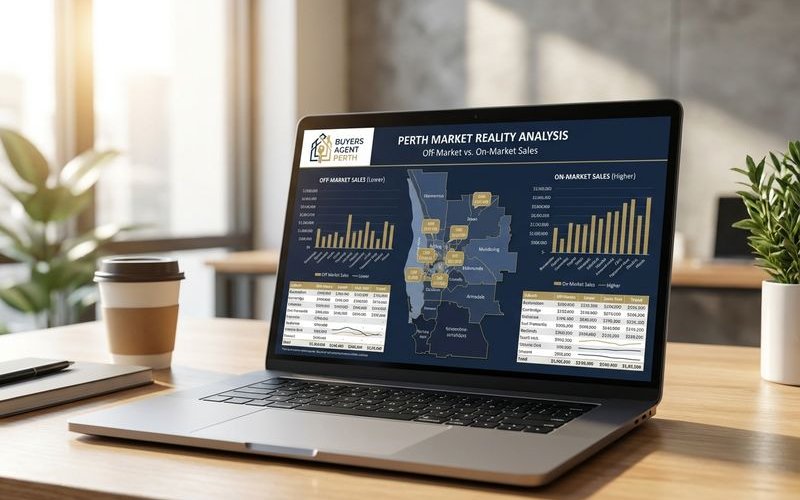
Some off-market properties are bargains, but plenty command a premium. We find sellers often go off-market specifically to test a high price without damaging their property’s digital footprint. With no public data, there’s no “days on market” counter ticking up, so vendors can hold out for an above-market offer.
Why Prices Vary:
- Testing premiums: Sellers may have unrealistic expectations and want to see if a database buyer will bite before paying for advertising.
- Marketing savings: A vendor saves roughly $3,000 to $6,000 in Perth by avoiding portal listings (like realestate.com.au) and signboards.
- Privacy premiums: Sellers in high-end suburbs like Cottesloe or Dalkeith often demand a higher price in exchange for allowing strangers into their home without a public campaign.
- Agent appraisals: Without public scrutiny, initial price guides can be optimistic.
The Truth
Off-market removes public competition, which can lead to better prices, but it also removes the transparency of a public auction or offer process. Better prices require negotiation based on comparable sales, not the listing status.
Approach: Evaluate off-market properties with the same price discipline as any purchase. We recommend asking the agent for a Comparative Market Analysis (CMA) immediately to justify the asking price. Compare recent sales in the specific street, not just the suburb.
Myth 2: Off-Market Means Zero Competition
The Myth
An off-market property is offered exclusively to you. No other buyers involved.
The Reality
“Off-market” means not publicly advertised on major portals. It does not mean you are the only person seeing it.
We frequently see “silent listings” blasted out to email databases containing thousands of active subscribers. In these scenarios, you are competing against every other buyer on that agency’s VIP list, as well as every buyer’s agent who covers that territory.
How Competition Exists:
- Database blasts: Agencies send “sneak peeks” to their entire CRM (Customer Relationship Management) list simultaneously.
- Cross-agency networking: Agents often tip off colleagues who have qualified buyers ready to transact.
- Buyer’s agents: Professionals tracking the market will likely know about the property within hours of the listing authority being signed.
- Invisible offers: You cannot see the other people at the home open, but their written offers are just as real.
The Truth
Competition is typically reduced but not eliminated. You might be one of 2-3 serious parties instead of the 15 you would see at a public open home.
Approach: Assume you are in a competitive situation. We advise clients to make strong, unconditional offers promptly if the diligence checks out. Acting slow because you think you are “safe” is a common error.
Myth 3: All “Off-Market” Labels Are Genuine
The Myth
If an agent calls something “off-market,” it genuinely has not been publicly marketed.
The Reality
“Off-market” is sometimes a rebranding strategy rather than a factual description.
We categorize properties into three distinct buckets to help buyers understand what they are actually looking at. Misunderstanding these categories creates a false sense of opportunity.
The Three Types of “Quiet” Listings:
| Type | Description | Buyer Advantage |
|---|---|---|
| Pre-Market | Signed up but photos/copy aren’t ready yet. Will be on portals in 7-14 days. | Speed. You get a first look before the masses. |
| True Off-Market | Seller has specific reasons (privacy/tenant) to never go online. | Exclusivity. You see what others miss. |
| Re-Market | Property failed to sell publicly 3 months ago and is now “quietly” available. | Leverage. The seller is likely fatigued and motivated. |
Common Misleading Uses:
- The “failed” campaign: A property that sat on domain.com.au for 90 days is taken down and offered “off-market” to refresh interest.
- The “coming soon” tease: Agents use this to build momentum for a public launch, not to sell it quietly.
- The pocket listing: A property is on the agent’s own website but not the portals.
The Truth
Genuine off-market means the property hasn’t been, and may never be, publicly advertised. Everything else is a variation of public marketing strategy.
Approach: Ask directly: “Has this property been publicly marketed in the last 12 months?” Verifying the history on platforms like RP Data or CoreLogic prevents you from overpaying for stale stock.
Myth 4: You Need Connections to Access Off-Market
The Myth
Off-market properties are reserved for wealthy elites with insider networks.
The Reality
Off-market access is available to any qualified buyer willing to do the legwork or pay for representation.
We know that agents prioritize buyers who are “transaction-ready,” regardless of their social status. An agent will show an off-market deal to a first-home buyer with pre-approval just as quickly as a wealthy investor, provided that buyer is easy to deal with.
Access Methods:
- Register with agents: Call the top 5 selling agents in your target suburb. Ask to be on their “VIP email list.”
- Engage a professional: Buyer’s agents (often members of REBAA) charge a fee but have established pipelines for these deals.
- Direct mail: Writing letters to owners in specific streets can yield results, though the conversion rate is low.
- Networking: Let local business owners know you are looking; word of mouth travels fast in tight-knit communities.
The Truth
Connections streamline the process, but they can be built. The real barrier is effort and intentionality, not elite status.
Approach: Commit to active pursuit. We suggest spending 30 minutes each week calling local agents to stay top-of-mind. If you lack the time, hiring a professional bridges that gap immediately.
Myth 5: Off-Market Properties Are Higher Quality
The Myth
Properties sold off-market are premium, exclusive, or somehow superior.
The Reality
Off-market properties span the entire quality spectrum, from luxury estates to major renovation projects.
We often see “fixer-uppers” sold off-market because the owners do not want neighbors seeing the poor condition of the interior on the internet. Conversely, pristine luxury homes sell quietly to maintain the owner’s privacy.
Why Properties Go Off-Market:
Good Reasons:
- Privacy: High-profile owners or those going through a separation often avoid public signs.
- Tenants: Landlords may sell quietly to avoid disturbing a good tenant with open homes.
- Speed: A seller who has bought elsewhere needs an unconditional contract fast.
Concerning Reasons:
- Defects: Structural issues that would be obvious in a public campaign are harder to spot in a private viewing.
- Unrealistic Price: The seller wants a price the public market would reject immediately.
- Testing: The seller isn’t truly motivated and is just “seeing what happens.”
The Truth
Off-market is a sales channel, not a quality indicator. Premium properties and problem properties both sell off-market.
Approach: Apply standard due diligence regardless of how you found the property. We insist on independent building and pest inspections for every private treaty sale. Off-market status does not reduce the need for caution.

Myth 6: Off-Market Negotiations Are Easier
The Myth
Without competition pressure, sellers accept any reasonable offer quickly.
The Reality
Off-market negotiations can be deceptively difficult due to a lack of “social proof.”
We find that in a public auction, the underbidders confirm the value for the seller. In an off-market scenario, the seller has no other offers to benchmark against yours, often leading them to believe they could get more if they “just went online.”
What Affects Difficulty:
- Feedback loops: A public campaign generates distinct feedback (e.g., “10 groups said the kitchen needs work”). Off-market sellers miss this reality check.
- Time pressure: Public campaigns have a deadline (auction date). Off-market deals can drag on without a forcing function.
- Motivation: If the seller is “testing” the market, they will be inflexible on price.
The Truth
Off-market removes some pressure but doesn’t guarantee easy negotiations. Unmotivated sellers with unrealistic expectations exist in any market.
Approach: Assess seller motivation before committing significant effort. We recommend asking: “What is the reason for selling now?” The answer tells you if you are negotiating with a motivated vendor or a dreamer.
Myth 7: Buyers Agents Have Secret Exclusive Access
The Myth
Buyers agents access a hidden market unavailable to regular buyers.
The Reality
Buyers agents have relationship advantages and speed, not locked doors.
We work alongside many buyer’s agents, and while they are efficient, they are fishing in the same ponds available to the public. Their value lies in the speed of information and their ability to qualify opportunities, not in a secret key.
What Buyers Agents Actually Leverage:
- Trust: Selling agents know a BA’s client is qualified, so they call them first.
- Volume: They see 20 properties a week, whereas a regular buyer sees two.
- Process: They know exactly who to call at every agency in Perth to find upcoming stock.
- Filtration: They filter out the “fake” off-market deals mentioned in Myth 3.
The Truth
Buyers agents’ advantage is efficiency and relationships, not exclusive access. The same opportunities theoretically exist for DIY buyers willing to invest equivalent time.
Approach: Decide if your time or money is more valuable. Buyers agents save significant time; doing it yourself saves the fee but requires a part-time job level of effort.
Myth 8: Off-Market Is Always Better Than Public
The Myth
You should only consider off-market properties; public listings are inferior.
The Reality
Both channels offer opportunities. The best property for you might be publicly listed right now.
We advise against “tunnel vision.” Ignoring the 80% of properties that are listed publicly means missing out on the bulk of the market inventory.
Comparing the Channels:
- Public Listings: offer price transparency, clear deadlines, and a wide selection.
- Off-Market: offers privacy, reduced competition, and potential speed.
When Public Works Better:
- Price Discovery: You can see exactly what others are willing to pay.
- Choice: You can compare 10 similar homes in one weekend.
- Transparency: Sellers are legally committed to the sale process.
The Truth
Smart buyers consider both channels. Excluding public properties limits options unnecessarily.
Approach: Don’t be dogmatic. Consider all suitable properties regardless of listing status. Our strategy involves reviewing public listings on Thursday and calling agents for off-market stock on Tuesday.
How to Spot Genuine Off-Market Opportunities
Ask these questions to cut through the noise:
-
“Has this been listed publicly before?” If yes, you are looking at residual stock, not a fresh opportunity.
-
“Will this go public if I don’t buy?” If the answer is “yes, next week,” you are in a pre-market race, not an off-market negotiation.
-
“How many other buyers have you emailed this to?” Honest agents will indicate if this is a mass-blast or a targeted phone call.
-
“Why is the seller choosing this method?” A clear reason (e.g., “ill health,” “work transfer”) suggests a genuine transaction. Vague answers suggest price testing.
-
“Is there a signed listing authority?” Agents cannot legally sell a property without this. If they hesitate, the deal isn’t real.
The Bottom Line
Off-market offers genuine advantages in the right circumstances. We have seen clients secure incredible homes quietly because they understood the rules of engagement.
Key advantages include:
- Reduced (not zero) competition
- Potential (not guaranteed) price benefits
- More time for building inspections and finance approval
- Access to privacy-focused sellers
But off-market isn’t magic. Approach opportunities with the same diligence and analysis you would apply to any purchase.
The best off-market opportunities come to prepared, qualified, quick-acting buyers who understand reality rather than mythology.
Looking for genuine off-market opportunities? We separate real opportunities from marketing spin, presenting only verified off-market properties matching your requirements.
Book a consultation to discuss off-market access done properly.
Topics
Related Service
Comprehensive end-to-end buyers agency service from initial strategy to settlement. We handle everything - property search, evaluation, negotiation, and coordination.
Learn About Complete ServiceBuyers Agent Perth
Off-Market Specialist
Expert property advice from the Buyers Agent Perth team. We help Perth buyers find and secure their ideal properties.